


Ruben Blades Deposits His Legacy in the Cervantes Institute’s Vault of Letters
Rubén Blades deposited symbols of his musical career in the Caja de las Letras of the Instituto Cervantes, recognizing the collective value of his work and the importance of culture as a space of community.
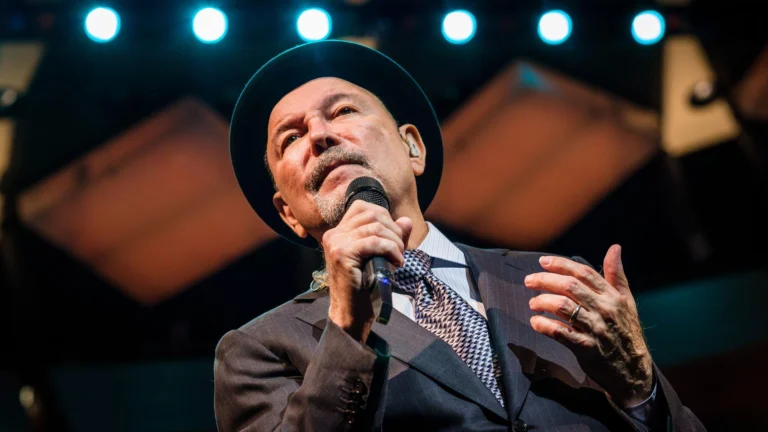
Rubén Blades hands over his maracas and the manuscript of ‘Patria’ at the Central America Counts Festival in Panama. Photo: Grammy
May 25, 2026 Hour: 8:52 am
🔗 Comparte este artículo
On Saturday, Panamanian singer-songwriter Rubén Blades donated his salsa maracas, adorned with the Panamanian flag, and a manuscript of his song “Patria” to the Cervantes Institute’s Vault of Letters. The donation was made during the closing ceremony of the Central America Counts Festival, held in Panama City since May 18.
RELATED:
Puerto Rican Salsa Singer Sammy Marrero Dies at 84
Blades, 77, internationally recognized for songs like “Pedro Navaja,” presented the items to the director of the Cervantes Institute, Luis García Montero.
During the ceremony, the artist signed the maracas, briefly played them for an audience, and then handed them to Montero, who placed them in a case containing the manuscript of “Patria.” This legacy will be transferred to the Vault of Letters for safekeeping by the Spanish institution.
Montero highlighted that Rubén Blades transformed salsa into urban chronicle, historical consciousness, and a transnational emotional community, expanding the narrative and cultural possibilities of Caribbean popular music from Panama, the Caribbean, and the Latino diaspora in New York.
The text reads, ““Maestra Vida” is one of the most ambitious and transcendent works in the history of Latin music. Composed entirely by the Panamanian singer-songwriter”
Rubén Blades and produced by the trombonist Willie Colón, it was released to the market in 1980 under the Fania Records label.
The director of the Cervantes Institute underscored the ethical weight of Blades’ songs and noted that perhaps therein lies one of the most profound lessons of his work: positioning culture as conversation, as common ground, even in disagreement, and music and literature as places where it is still possible to recognize one another.
For his part, the Panamanian singer-songwriter, winner of multiple Grammy Awards, thanked Montero for his words and reiterated that his work benefits from the contributions of many people.
“This is never the work of just one person; it’s always a series of contributions that bring you to this place. There are people better than me, people who are more deserving, who haven’t had the opportunity,” affirmed the activist and former Minister of Tourism of Panama.
This act strengthens the link between Panamanian culture and the institutions that preserve Hispanic American heritage.
Author: HGV/JF
Source: Grammy.com